
PocketGuard review: the clearest view of safe-to-spend money
PocketGuard is our best budgeting app for most people in 2026, scoring 4.8 out of 5 after 42 days of daily use. Its “In My Pocket” number turns balances, bills, goals, and planned spending into one useful answer. Choose it for strong automation; look elsewhere for deep investment analysis or strict zero-based budgeting.
What worked
- Excellent safe-to-spend calculation
- Fast automatic transaction handling
- Useful free plan and flexible Plus options
- Practical debt-payoff planning
What did not
- Occasional connection delays
- Limited investment depth
- Best controls sit behind Plus
- Couples lack polished separate profiles
The verdict after 42 days
Most budget apps are good at showing what already happened. PocketGuard is unusually good at answering the next question: what can I spend today without colliding with rent, a goal, or a category limit? We tested the iOS app and web view with one checking account, savings, two credit cards, six recurring bills, and 286 posted transactions. Setup took 11 minutes; the useful dashboard appeared before we had manually built a category tree.
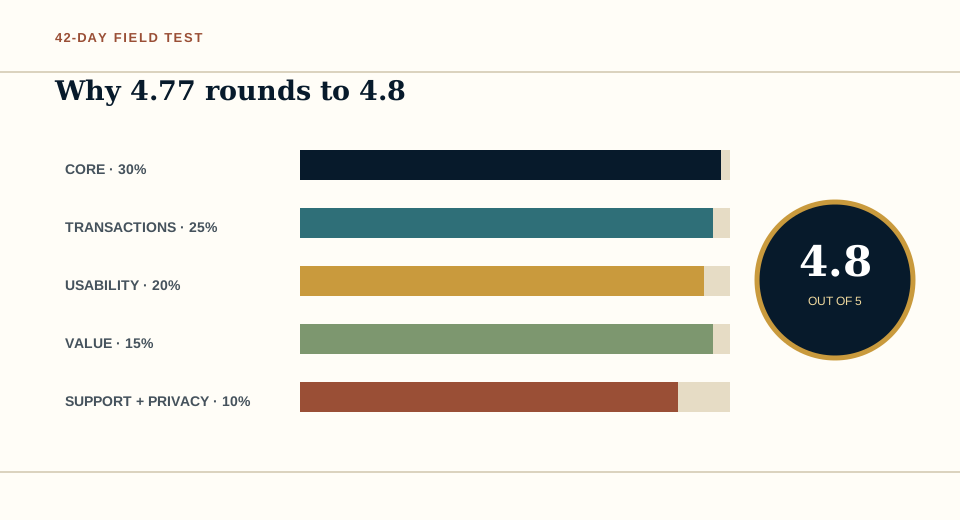
Our six-statement stress test checks the arithmetic behind the feature. The signature “In My Pocket” figure subtracts upcoming bills, planned contributions, and budgeted spending from available funds. It is not permission to spend blindly—the quality of the answer depends on complete accounts and accurate recurring bills—but it is more actionable than a raw balance. PocketGuard found five of six recurring bills on its own. The missed annual charge was easy to add manually.
| Category | Weight | Score | Weighted points |
|---|---|---|---|
| Core budgeting Plans, goals, bills, safe-to-spend view | 30% | 4.9/5 | 1.47 |
| Transaction handling Sync, categories, rules, corrections | 25% | 4.8/5 | 1.20 |
| Usability Setup, navigation, accessibility | 20% | 4.7/5 | 0.94 |
| Value Free utility and paid price | 15% | 4.8/5 | 0.72 |
| Support & privacy Help, export, data controls | 10% | 4.4/5 | 0.44 |
| Total | 4.77 → 4.8/5 | ||
Budgeting and transaction accuracy
PocketGuard correctly categorized 257 of 286 transactions on first review, or 89.9%. That is a practical result, not a claim of universal accuracy: local merchants and payment processors will change the outcome. Corrections were quick, and Plus users can create merchant and category rules so a fix becomes durable. Split transactions handled a supermarket purchase divided between groceries and household goods without awkward workarounds.
Budget creation is more guided than Goodbudget’s envelope ritual and less doctrinaire than YNAB’s assign-every-dollar method. Category limits can be changed as the month unfolds, while goals and debt tools keep longer-term priorities visible. Readers who need a system to impose a new habit may find that flexibility too permissive. Readers who want a calm dashboard for an existing life will likely appreciate it.
Price and value in 2026
PocketGuard maintains a useful free tier with bank connections, budgeting, transaction tracking, and bill visibility. As listed on the official PocketGuard site on August 5, 2026, Plus cost $12.99 per month, $74.99 per year, or $99.99 for lifetime access. Prices and promotions can change, especially in app stores, so confirm the checkout total.
Annual Plus works out to about $6.25 a month. That is fair for unlimited categories and budgets, transaction rules, cash tracking, debt-payoff features, and added customization. The lifetime option breaks even against the annual plan after roughly 16 months, but “lifetime” always depends on the product continuing to operate. Start free, identify a specific limitation, then upgrade; the free plan is capable enough to make that decision with evidence.
Where PocketGuard falls short
Two linked accounts needed a manual refresh during testing, and one credit-card connection lagged until the following morning. That is normal aggregator friction, but it weakens any dashboard that presents a precise present-tense number. PocketGuard should make the freshness of every account impossible to miss beside “In My Pocket,” not leave readers to inspect connections.
Investment coverage is a broad net-worth view, not analysis. It will not replace Empower for allocation and fee visibility. Household collaboration also feels like sharing a view rather than maintaining distinct roles. Our PocketGuard vs. Goodbudget comparison explains why Goodbudget may suit couples who hold a weekly envelope meeting.
Who should choose it?
Choose PocketGuard if your main problem is uncertainty between paydays: you can see money in checking but cannot tell what is already spoken for. It also suits people graduating from passive expense tracking who do not want a rigorous budgeting course. It ranks first in our seven-app comparison because the core answer is quick, useful, and available before customization becomes a hobby.
Skip it if you require detailed portfolio tools, desktop-class reporting, or a manual envelope routine. In those cases, use our selection guide to match the method to the problem. PocketGuard is the best all-around vessel in this harbor, not the only one seaworthy.
Questions before you connect an account
Is PocketGuard free in 2026?
Yes. PocketGuard offers a free plan with connected accounts, budgeting, transaction tracking, and its recurring-bill view. PocketGuard Plus unlocks unlimited budgets and categories, debt-payoff planning, cash tracking, transaction rules, and other controls. On August 5, 2026, Plus was listed at $12.99 monthly, $74.99 yearly, or $99.99 for lifetime access.
Is PocketGuard safe to connect to a bank?
PocketGuard says it uses encryption, PIN and biometric controls, and read-only bank connections through established data providers, so it cannot move money from linked accounts. No aggregator is immune to outages, and connecting accounts still shares financial data with service providers. Use a unique password, enable available device security, and review the current privacy policy.
Does PocketGuard work for couples?
It can work well when a couple treats one PocketGuard profile as a shared household view, but it is less elegant for partners who want distinct logins and permissions. Goodbudget’s envelope sharing is more deliberate for joint planning. PocketGuard is better when the priority is automatic account aggregation and a current household spending number.
Who should avoid PocketGuard?
Avoid PocketGuard if you want granular investment analysis, a strict assign-every-dollar ritual, or complete separation from bank-data aggregators. Investors will get more from Empower; dedicated zero-based budgeters may prefer YNAB or Goodbudget. PocketGuard is designed for everyday cash-flow decisions, not portfolio construction or accounting-level reconciliation.